Showing posts with label brainy bombshell. Show all posts

Saturday, November 28, 2009

Titillation for the Tiny Tot

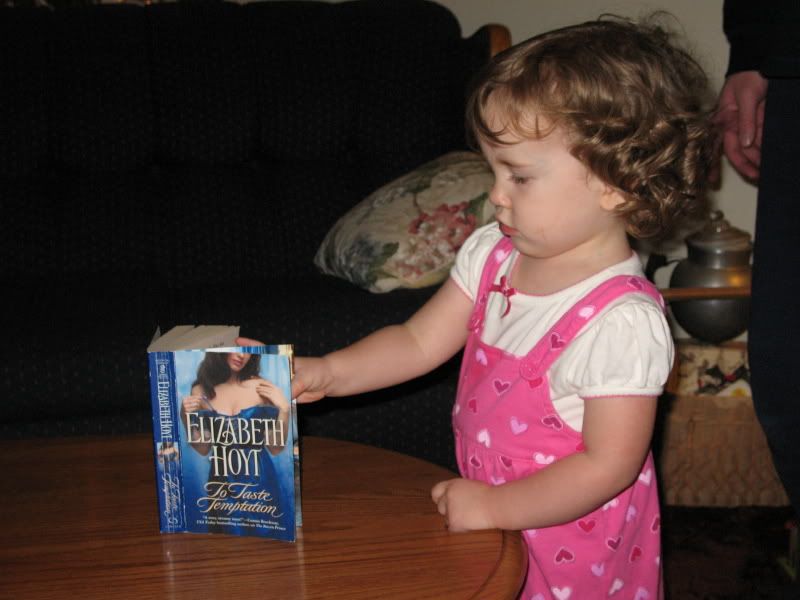
Check it out! My niece has already ditched the G-rated books in favor of steamier romance reading. And she's not even 2 years old yet... I'm so proud!

My brother and I couldn't stop cracking up when his daughter made a beeline for the bodice-rippers. It made me wonder when she'll actually start reading romance... a question that already has my sister-in-law nervous.

I am not a parent yet. As both a high school English teacher and an aspiring novelist, I'm a big fan of free speech. I'm against censorship. I was also a pretty lucky kid with a truly awesome mom who never told me I wasn't allowed to read something. Consequently, I always felt comfortable telling her what I was reading. I wasn't forced to hide my romance novels under the bed. I never thought of them as soft-core porn or something shameful.

And yet... I'm not sure how I'd feel if I had a precocious 9-year-old daughter who wanted to read erotica.

So I want to know... what was your first romance novel? What are your favorite books to reread, and why? And if any of you are parents, how do you feel about your own children potentially reading romance someday?

Friday, September 04, 2009

What Makes A Good Book Good?

Earlier this week, I was having a hardcore wallow over the uninspired pap I was scribbling all over my WIP. I knew I needed the jolt of eagerness and excitement over the written word that I can only get from a Really Good Book.

My RGB of choice was Dogs & Goddesses by the divine Jennifer Crusie, deific Anne Stuart, and transcendent Lani Diane Rich. And it worked. Whammo! Popped me right out of my funk. I'm writing great gobs of goodness into my WIP and life is good again.

But then I got to thinking. What makes a RGB so good?

We could dissect it. Break it down into pieces and examine the parts, but a book autopsy only works on dead items and Really Good Books are alive to me. Please, let's not kill them. They are so pretty as a whole, must we suck the life out of them and hack them apart? Does it have to be the dialogue or the characterization or the plot arc? Could it possibly be some kind of magical alchemy? An X-factor that takes a good book with all those dry ingredients and adds a juicy slug of wow to the pages.

I don't think a truly excellent work of literary fiction is any more quantifiable than popular/genre fiction. Can you describe to me exactly what makes Dickens more enduring than his contemporaries? What separates Steinbeck or Alcott from theirs? Entire literary theses are written in the attempt, but those theses tell us as much about the reader and what they bring to the work as they do about the work itself.

In one of Jasper Fforde's Thursday Next books (RGBs!) - I think it was The Well of Lost Plots, but I can't be sure - he talks about how much work a reader does, what percentage of the book experience is fueled by the reader versus the words themselves. Words are just words. The reader is the one who makes them worlds and people and ideas.

I was lucky enough to see Jennifer Crusie speak while I was in Ohio a couple months ago. One of the things she mentioned was leaving enough room in the manuscript for the reader to get inside and make themselves at home. This really got me thinking about the accessibility of books. Some are thick and dense, with not a lot of wiggle room, and not terribly cozy for a reader to crawl inside. But sometimes those difficult reading experiences can be just as, or even far more, rewarding than the easy ones which throw out the welcome mat.

I'm kind of in love with that metaphor now - the book as a living space. I'm picturing some of the difficult ones as being cramped and having major electrical problems, so you're pressed up against the wall and get periodic shocks as the book jolts you into opening up a part of your brain you hadn't accessed before. Electro-shock-reading!

To me, a RGB is not any particular kind of book, but rather a reading experience. I love classic literature. (Well, some of it. My hatred for James Joyce is a living, breathing thing.) But I also read copious amounts of genre fiction. I tend to think that genre fiction exists to take you out of yourself (those wide open doors of the accessible book) whereas lit fic exists to put you back in and make you take a hard look around (and maybe shock open a few new neural pathways). And both are valuable.

You cannot force someone to love electro-shock-reading any more than you can force them to respect the "easy" read. In this article at Smart Bitches, Candy talks about mandatory reading lists and the cold war between lit snobs and genre slobs. Can't we all just get along? Why does one have to be better than the other?

Eloisa James told a story at the National Conference about the difficulties of being a genre writer in a family of literary snobs. She kept being asked when she was going to write a "real" book. (If you've never read Eloisa James, do it now. Those books are real. And utterly brilliant.)

I can understand her frustration, but (don't hate me!) I can also see the other side. I love romance. I love writing romance. But I want to write a Big Book someday that examines and impacts society in a way a happily-ever-after could not do. So I can't take offense when people ask me when I'm going to write something real. Yeah, it sucks that they don't respect what I'm doing now, but I understand that to them a RGB has to be electro-shocky and romance just ain't. One man's RGB is another man's uninspired pap (or James Joyce).

And now I'm off topic... does anyone remember what I set out to say when I sat down to write this post? Something about Really Good Books? And what makes them good?

My verdict: Magic. And a place for the reader to climb inside. Really, it's all up to the reader. Not to diminish the work writers do, but without the reader's imagination, where would we be?

Your thoughts?

Monday, June 29, 2009

Comeuppance

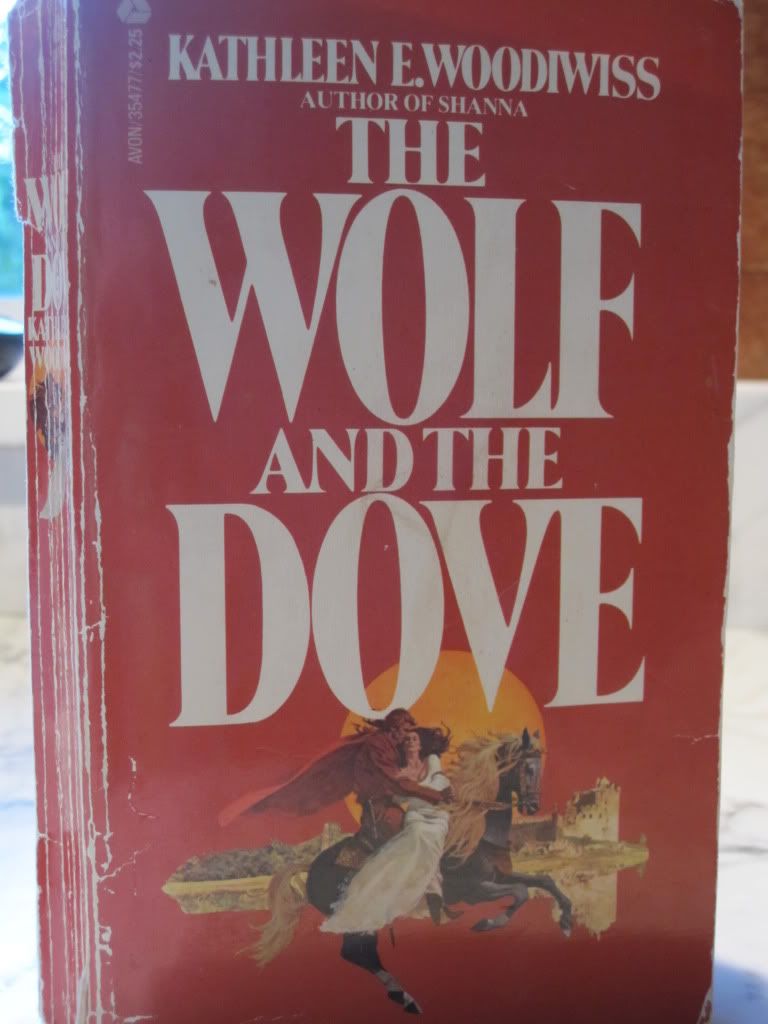
Last month I followed Kate and Vivi's advice and bought a copy of Beyond Heaving Bosoms, Sarah Wendell and Candy Tan's book based on the Smart Bitches, Trashy Books blog. On vacation last week I managed to sneak away and indulge a few chapters. Reading their analysis of Old Skool romances such as Kathleen E. Woodiwiss's The Flame and the Flower, I had one of those "I can do that" moments familiar to both crafters and aspiring authors. I resolved to go to the scary basement, unearth the bin of books from under the Christmas lights, and find The Wolf and the Dove, a Woodiwiss book I read twenty times during high school but not since. I remembered a Saxon maiden chained to the hearth by the Norman warrior who pillages her home. That would fit Sarah and Candy's description:


[I]t was well-nigh de rigeur for the heroine to be raped by the hero in those novels. The rape would be justified in any number of ways with the framework of the story ... Sometimes, the heroine was the spoils of war, so clearly, it was acceptable to rape her. Other times, the hero would assume the heroine was sexually experienced, and as we all know, rape counts only if the rapist knows the victim is a virgin.

I decided to blog using the Smart Bitches' methodology to analyze this old favorite, racking points for every "forced kiss - and she likes it" scene. I planned to ask you, Dear Reader, to play this parlor game with me. We would all be snarky New Skool romance fans together, bemoaning chained to the bed/hearth/ship's wheel/dirigible scenes, competing to rewrite overly modified sentences and rework similes beaten into "limp exhaustion," pointing out spears of manhood and other sexual euphemisms for our intellectual titillation.


I found the book box easily. The 1974 copyright date and $2.25 cover price dovetailed with my expectations. Filled with smugness and caffeine, I began to read and take notes, eager to line up this stereotypical Old Skool romance with the Beyond Heaving Bosoms flowchart.

I stumbled. Some bad guy named Ragnor, not the hero Wulfgar, is the one who rapes her (although, Candy and Sarah were correct in that Kathleen Woodiwiss contrived to have Aislinn and the villain consume sleeping herbs so in fact no actual bad guy rape occurred, thus the heroine was a technical albeit unaware virgin for the hero).

Sure, I found several forced kisses, such as page 40 where she slaps him, in front of his men, for mocking her and his retribution is ... "Without word or warning Wulfgar's hands were upon her like slaves' armlets." May I say, that is powerful writing? Read it out loud. Not an extra modifier lurking in that line. The repeated "w" sounds like a whip, doesn't it? Oh, the rhythm. It takes me hours to write like that.

Oops, it was her Saxon fiance chained to the hearth for trying to stab Wulfgar, who spares the poor guy and eventually elevates him to Sheriff. That's kind of progressive in 1066, isn't it? I am totally failing at snarkiness and remembering why I loved this book twenty years ago.

The Smart Bitches claim "most of these Old Skool romances were written solely or mostly from the heroine's viewpoint." But Woodiwiss does a fair amount of head-hopping, regularly giving Wulfgar his own point of view, such as this man-angst:
Was this to be his lot? To find her ever close at hand yet never know again the privacy with her that had been before. Was this marriage? To have a babe more oft between them than finding a moment to share long suffering passions? He sighed and turned his stare to the fire. Winter comes, he thought. And the nights are long.
Who among us is married with children and doesn't feel that? Woodiwiss wrote the thesis for Michael Lewis' new book Home Game when that dude still had baby teeth. The Wolf and the Dove is thirty-five years old, but it stills rocks and I feel ashamed at my pathetic intent.

I must apologize to the spirit of Kathleen E. Woodiwiss for assuming I could dismiss and mock a book that was already in its thirty-second printing twenty years ago, and remains in print and even ebook. I must apologize to my sixteen, seventeen and eighteen-year old selves for doubting their taste and judgment in reading material. And I must apologize for thinking I could convince you to play along with a petty game.

Let's try something nicer instead. I liked that paragraph from Wulf's point of view. Can you post a pre-1986 or so hero POV scene that you like? Something from the '70s or early '80s that reminds us all why we like those books (despite the arm-gripping). Brave your own scary basement, find a hero you've lugged around for longer than your favorite jeans, and put it up here.

Monday, June 22, 2009

The Love That Dare Not Speak Its Name


I was inspired by Zeek's Supernatural post awhile back. In it, she mentions the show's reference to the wide world of slash fiction. If you're not familiar, slash fiction is fan fiction that depicts romantic or sexual relationships between characters of the same-sex. In other words, stories depicting Captain Kirk and Spock making sweet, sweet love on the bridge of the Enterprise.

Now, one of the best academic discussions I've ever seen of slash fiction happened in the Bitch magazine article "Fan/tastic Voyage." Check it out if you want a truly thoughtful exploration of the implications of slash. (Slash writers = predominantly straight women. Slash audience = mostly other women. So why the focus on male/male romantic relationships? This is what the article explores.)

While I admire the article, I do not aspire to such lofty heights of feminist analysis here. I honestly just wanted to give you the recut Top Gun trailer. If you can't view the video at the top of this post, you can always follow the link here.

I don't know about you, but I thought the recut trailer was hilarious. If nothing else, it reminded me about the importance of editing! My, my... how it shapes a story...

What did you think? Did anyone else do a spit-take with their coffee?

Wednesday, June 17, 2009

Plot Happens in Vegas...

A few days ago, I promised to write about the Get-Drunk-and-Wake-Up-Married storyline, or as I call it, the Vegas Plot.

My new WIP is set primarily in Vegas, and for the longest time I didn't connect my love of cheesy strangers-getting-married-plots to my need to set the book there. After all, my hero and heroine already know each other before traveling to Sin City (they don't like each other, but they know each other). Given their reasons for visiting Vegas, I doubt they'll be hitting the craps tables and winding up at an all-night wedding chapel. And yet...

And yet, when you want to take two all-business characters and force them to get a little freaky, there's no better spot to set your story than Vegas. And not just in books or movies, as the perennial appearance of flicks like What Happens in Vegas or The Hangover prove. This year's summer pop hit (Katy Perry's "That's What you Get For Waking up in Vegas") bears a striking resemblance to last year's summer pop hit (Carrie Underwood's "I Don't Even Know His Last Name").

To bring things back to the realm of literature, Vegas operates in our cultural mythology like the forest in a Shakespearean comedy. In plays like As You Like It and (most notably) A Midsummer Night's Dream, characters leave the city and enter the forest, where they don disguises and alternate identities, where they experiment with different lovers and try on new relationships, where they reorder their place in world. It's an experience at turns jarring, confusing, exhilerating, freeing, and confining. When the characters leave the forest--after one long night or several long years--they return to their accustomed places in society and resume their usual relationships. But they bring something of their experience in the forest with them--a sense of the possibilities for anarchy and change that exist even in the most ossified institutions and rigid identities.

Doesn't that sound just like Vegas in 21st-century America? A confined and separate place where constrained and contained people can give free rein to the elements of themselves unallowable in their ordinary lives. A place where the promise that "What Happens in Vegas, Stays in Vegas" allows for the kind of role playing the hero or heroine of a Shakespearean comedy would recognize as his or her birthright.

Of course, for contemporary writers, the real interest comes not with the loosening of morals in the secret, sacred space of Vegas. We can see unrestrained ids on display every night of the week on reality tv. For us, the more interesting question is, "What Happens When Vegas Doesn't Stay Put?" When the Forest of Arden invades the court? Or when you wake up married in Vegas and have to go back to work in Cincinnati?

And then there's the biggest benefit of all to the Vegas-set story: Research trips!

If you're a writer-- what locations inspire you most? And since we're all readers-- do you love stories set on cruises? In European locations? In small towns? What kind of setting grabs you...and why?

Sunday, June 14, 2009

Yums and Yucks (and Guilty Pleasures)


Every reader of romance has her (or his!) mental list of yums and yucks. Mine look something like this:

Anneliese's Yums
  • Second-time-around Stories
  • Getting-to-Know-You Banter
  • Hate Sex
  • Heroines with Shady Pasts
  • Super Angsty Heroes

Anneliese's Yucks
  • Virgin Widows
  • Forced Sex
  • Too-Stupid-to-Live "Plucky" Heroines
  • Super Asshole-y Heroes
  • Vampires (I know, I'm not a red-blooded American woman or something)

In addition to these guaranteed pick-me-ups and throw-me-aways, I've got another list. Super-cliched romance plot devices that I KNOW are ridiculous, but can't help loving. It boils down to two items.

Anneliese's Guilty Pleasures
  • Secret Babies
  • People Getting Drunk and Waking Up Married

Yup, if you're wondering who's buying all those Harlequin Presents titles about secretaries who get knocked up after a night with the boss and hide the resulting child for six years, it's me. If you can't understand why another movie about two drunk idiots tying the knot in Vegas just got greenlit, look my way.

I'll be posting in a few days about the lure of the Vegas plot and why I think it grabs readers/writers/audiences, so let me take a moment now to tease out my motivations for loving the secret babies.

I think it's all about control, gaining it and losing it. The mother's position of dominance as holder of the secret probably lies at the back of it. And then there's the moment when the father realizes the truth about his child's paternity. They're always angry, and shocked, and excited, and nervous, and sad, and happy. They're thrown out of their element, even if they act all lordly and commanding. They're reminded that they don't really control the women in their lives, even when they think they do (and they usually think they do, at least in historicals). Damn, that's so hot!

If the enjoyment of fiction requires the willing suspension of disbelief, I'm willing to take my disbelief, tie a forty-pound weight to it, and drop it out a twelve-story window for the sake of a secret baby or a drunk Vegas wedding.

How about you? What are your Yucks and Yums and Guilty Pleasures? Is there any plot that gets you every time, no matter how ridiculously unbelievable? And most important...why do you love them?

Sunday, April 26, 2009

What Your Mama Told You


I'm back from the Romance Conference at Princeton--and wow, do I have a lot to report. It was a fascinating event, with some great papers and presenters...but I need time to process before I can give a full update. There was just too much to fit in my brain and spit it back out neatly.

As a teaser: a story and a question. Sarah Frantz, one of the academics in attendance, told a story in the context of her paper about reading her first BDSM romance--a relatively tame Harlequin that was handed to her by her mother with the remark "This one has bondage!" when she was fifteen.

I know a lot of women were introduced to the romance genre by their mothers (or sometimes older sisters). I'm in the awkward position of having introduced my mother to the genre. She picked up her first romances after she learned I was writing one and working at a romance-related corporation (my former, pre-grad school job).

I'm a long way off from having a teen or pre-teen daughter. Or son for that matter. But I'm not sure whether I will be comfortable sharing romance novels with her or him. I hope I will be! I hope I'll be a published author well before then and that romances will be like wallpaper to my kids--ordinary, taken for granted aspects of their environment. Nothing to feel embarrassed or ashamed about.

So, to the Damned Scribbling Women and friends: How did you start reading romance? How should mothers and children (daughters and sons) relate together over romance novels?

Saturday, April 25, 2009

Snape Celebrates National Poetry Month

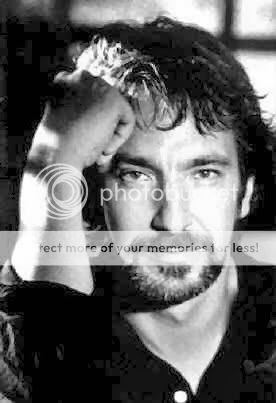
If loving Alan Rickman is wrong, I don't want to be right. And many of our readers agree with me!

While posting her list of character crushes, Maren said, "I look over that list, and realize that most of my fantasy character crushes are assholes and/or evil. Troubling. Which reminds me, add Professor Snape to that list."

Fist-the-Dead clearly agreed. In a later post on the same topic, she said, "I was dragged to "Harry Potter" by my friends thinking it would be totally lame. Then I saw Snape. I have to agree that he is an object of lust. He was like Trent Reznor, but a Trent Reznor who could give me detention for not wearing panties. And that my friends, is a good thing."

Love of Alan Rickman: clearly, it's a sign of fabulous taste. After all, the Smart Bitches agree with me--so much that they've posted an MP3 of Rickman reading Shakespeare's Sonnet 130. Hurray! This has got to be every brainy bombshell's secret fantasy. Shakespeare and Professor Snape, together at last?

Yes, please.

So take this moment, before April ends, to celebrate National Poetry Month. Melt a little, courtesy of the Bard and the Potions Professor.

Wednesday, April 15, 2009

Sex and the Ivy League English Department


As an apprentice academic and unpublished romance novelist, I sometimes feel caught between two worlds. People consumed by literary theory and the status of "high" art frequently have a way of blithely dismissing the entire romance genre as melodramatic, sentimental, out-dated, and even socially harmful trash--without ever picking up a Julia Quinn, or Susan Elizabeth Phillips, or Laura Kinsale to test those assumptions out. I've seen it and I've heard it, more times than I can count. Romance readers and writers can be just as tetchy, thanks to years of dismissive comments.

I'll probably follow Eloisa James' lead when I eventually get published--keep it incognito until you're established enough as an academic that you can say "pphhhht" to any potential criticism.

But while I'm hewing to the status quo, a bunch of talented scholars, writers, and readers are coming together to help bring romance into the critical conversation. At Princeton, no less!

From April 23-24, the Princeton University English Department is hosting a conference called "Love as the Practice of Freedom: Romance Fiction and American Culture."

This isn't some bull session for critics outside the genre to cast their judgment on it from on high. Several scholar/romance writers are presenting-- including Mary Bly/Eloisa James and Gwendolyn Pough/Gwyneth Bolton. They've got longtime bestsellers Jenny Crusie and Beverly Jenkins on the list, members of the reading community like Sarah Wendell of the scribbling women's beloved Smart Bitches, Trashy Books, and the President of RWA. And they have scholars doing trailblazing research on current romance fiction along with eminent scholars of romance in other periods, like Margaret Doody--whose work on Austen and Burney I turn to in my own research.

This looks like a great line-up! I'm lucky enough to be free on Thursdays and Fridays and to live close enough to Princeton to attend. I hope to see some other scribblers there. And I'll be sure to update everyone afterward on romance fiction's Ivy League debut.

Sunday, April 05, 2009

Why DSW?

The site's name comes from a Nathaniel Hawthorne quote. Way back in 1855, the famous author of The Scarlet Letter complained that “America is now wholly given over to a damned mob of scribbling women, and I should have no chance of success while the public taste is occupied with their trash--and should be ashamed of myself if I did succeed.”

Admittedly, using this quote is a nod to our nerdy side. However, we also reference it because we delight in the popularity (and power) of “scribbling women.” We also believe that the novels we write are uplifting and important (not trash!).

As the tagline on the site indicates, we are brainy bombshells who write red-hot romance. We write about the triumphs and challenges of the romance novelist’s life. To celebrate the return of DSW, we will have a plethora of new posts planned for this week.

Happy reading!

Wednesday, February 27, 2008

Just Call Me Doctor


Interrupting our usual D Scrib fare for a bout of shameless self promotion:

I'm getting a PhD! (trumpet fanfare)

I just received my first acceptance from a doctoral program in English. Still waiting on a few others (and on the funding details for this one), so I can't say for certain where I'll be next year. But I can say that I'll be studying 18th and 19th century British literature.

I'm totally psyched to know I'll be working toward this degree that's been a dream for so long. I'm a little nervous about what this will mean for my already delayed writing career. But those doubts can wait...at least a day!

Sunday, September 30, 2007

Of Rakes and Heroes


Currently, for my graduate class on the 18th-century novel, I'm slogging my way through Samuel Richardson's Clarissa. For those of you who have not had the pleasure of this pithy little 1,500 page monster, a brief summary: Boy meets girl. Girl's family tries to force her to marry a gross other guy. Boy tricks girl into running away with him to escape said family. Boy rapes girl. Girl dies. Fun times.

Despite its length and verbosity, the novel's actually much more entertaining than that dismissive description would suggest. The "Boy" himself, Lovelace, in particular, is a fascinating portrait of a clever, humorous, charming man with all his wits bent toward some rather unscrupulous ends.

As I'm reading, I find myself marveling at the way Lovelace conforms quite neatly to the image of your typical romance alpha hero. Commanding, brilliant, handsome, rich, titled: how is that not exactly the description of 6/8th of the heroes in historical romance? He feels certain he knows Clarissa's true desires better that she does. He plans to help her unlock the hedonism that surely lies in her seemingly virtuous soul (rape is sort of a last resort, if you will). He vows revenge on her family for attempting to keep them apart. Even contemporary romance makes use of the "lying to her for her own good" trope.

This is not meant as yet another excoriation of the anti-feminist backwardness of romance, by any means. I like a good alpha hero! Done well, they can be sympathetic, appealing, exciting, and sexy as hell. I even like Lovelace, when he's not crowing about how much sweeter the rake's victory feels when he wins it from an unwilling woman. (In this I'm not alone, as Richardson's 18th-century readers were so taken by Lovelace that they begged for him to be reformed by the love of Clarissa, and for the book to end in marriage rather than deaths--yeah, he dies too, in a duel).

I'm just wondering where we draw the line: in the books we read and in our own fiction. What separates the villain from the hero? I think I write pretty "good guy" heroes for the most part, maybe even beta men, and I often feel obligated to make them...a little meaner. As though, if they don't occasionally insult the heroine or go off and fight someone or get drunk, they're not "real" romance heroes.

Readers, please weigh on on where you stand. When does a hero become a villain? When can a villain become a hero? Where's your invisible line between redeemable and wretched?

Tuesday, August 21, 2007

Say Our Names

Big changes afoot here at Damned Scribbling Women, born of our rediscovered writing mojo. We're back, we're busy, and we're ready to tackle this business like never before.

So, to begin, a word about the shiny new names you see to the left of this post under "Meet the Scribbling Women." Kate D. is now the dazzling Kate Diamond, while theflitgirl has unveiled herself as Anneliese Kelly. We're tying the blog to our individual writing projects, so blogging under our writing names is a natural fit.

Yes, I said "writing names", not "names." Kate and I have followed in the footsteps of luminaries like Lemony Snicket, George Eliot, and all three of the Bronte sisters (Acton, Ellis and Currer Bell) in adopting pseudonyms, rather than publishing under our everyday names.

The decision to use a pseudonym of course brings up a host of conflicts and questions. It's fairly common in the romance industry, although increasingly less so. Writing under a name like Lulubelle von Flurryfeathers does feed into the stereotypes about this genre: frivolous, ridiculous, outdated, over-feminine. It also smacks of "hiding" behind a false name out of shame or embarrassment.

So why have two modern, unabashed women like us decided to go this route. For starters, both Kate and I are involved in education and literary studies. While we feel that writing romance only adds to our credentials as proud feminists, not all our current and potential bosses/teachers and coworkers/fellow students will agree. Additionally, the parents of the little darlings we instruct may not want to associate Junior's English teacher with lusty Regency dukes or shag sessions in lakeside cabins.

For me, however, there's another factor: my life-long love of names. Since I was a child I've poured over baby name books and as an adult must confess to an addiction to baby name messageboards. When else will I have the opportunity to name myself? My new name comes from my family history (my mother's maiden name) and from several of my favorite, most life-changing novels. Plus, it's pretty!

We'd love to hear from other readers and writers. What do you think about noms de plume? Would you/ Do you use one? Why are they more common in romance than any other genre, even mystery fiction?

Finally...what do you think of ours??

Tuesday, November 14, 2006

Eat Like A College Student, Write Like...

A Moveable Feast, indeed!

Every once in awhile I'm overcome with regret that I'm not an angry, chain-smoking ex-pat living in Paris during the 1920s. Tonight is one of those nights, and I blame it on the Hemingway lecture I'm preparing to give my students tomorrow. Why oh why couldn't I be a Great American Author, hanging out with other Greats as I pickle my liver in absinthe?

I suppose we all have our own form of greatness, just as we have our own Great Flaw. Hemingway wrote what are, in my opinion, the greatest American short stories of all time while he drank and wenched his way through life. My greatness? I'm still working on that one. The flaw, however, is over-committing myself to projects and people and then agonizing when I can't give every facet of my life the full attention it deserves.

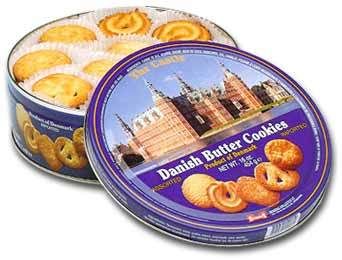
Hence this evening. After a long bubble bath, I decided to forego the pleasures of finishing up my essay-grading. I should feel ashamed, I know, but I'm suffering a bad case of burn-out and it's only first quarter. So instead, I'm drinking red wine and eating my first tin of Danish butter cookies since the Great Butter Cookie Overdose of 2000. (Oh, the thrills of finals period my junior year of college... but that's a tale for another time...)

I'm also thinking about why I teach, and why I seem to be ignoring my teaching philosophies on a day-to-day basis. I'm thinking about the books I want to write, but never finish, and the vacations I want to take, but never do. I'm thinking about the relationships that are important to me, and the way I tell myself, "I'll let them know how much I love them tomorrow."

Perhaps this all sounds incredibly depressing and I suppose, objectively, it is. But hey, at least if I died tomorrow none of my friends would portray me horribly in their autobiographies, as Ernest Hemingway did to F. Scott Fitzgerald (basically calling him “a drunk, a weakling, a hypochondriac, a fool, an irresponsible writer, a nuisance, sexually insecure and wife-dominated…”
[1])

Ouch! With friends like that, who needs enemies?

Tonight, I'm wondering what I'm really doing with my life. When will I stop putting off my own ambitions? How can I be the writer, sister, daughter, girlfriend, friend, teacher and "wild woman" I feel that I was born to be?

When do we stop waiting for our dreams and actually take a step towards achieving them?
Deep thoughts, I know, and not the usual norm for the public side of DSW. But hey, when I'm avoiding grading it makes me philosophical!

* * * * *

[1] Matthew J. Bruccoli, Fitzgerald and Hemingway: A Dangerous Friendship (New York: Carroll & Graf, 1995) 1.

Tuesday, July 04, 2006

Chick Power

I was delighted to see Libba Bray's web link devoted to the songs she listened to while writing A Great and Terrible Beauty. Because I, too, love a good playlist I will soon be posting an entry on songs that inspired Revising Mr. Right.

In the mean time, however, I submit to you the Dixie Chicks.

Let it first be mentioned that I love a good female bluegrass band. Let it also be said that, as a Civics teacher, I am a firm believer in free speech. And finally, as a feminist I think it's worth noting that the Chicks are the first female group in American music chart history to have three albums debut at #1.

They are also, however, one of the most controversial acts to ever play the Grand Old Opry. This Wikipedia entry summarizes their intriguing free speech brouhaha, but of course I can't resist giving you my own version! Basically, traditional country music fans' adoration of the Chicks turned to loathing when they criticized George W. Bush during a 2003 London concert. This faux pas engendered boycotts on most country radio stations, caused former listeners to toss their CDs under bulldozers and, of course, inspired the ever popular avalanche of death threats.

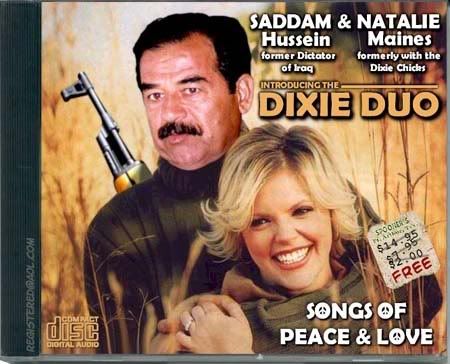
The protesters explained their disgust with the Chicks' actions as follows: "entertainers don't have a right to talk about their personal beliefs in music." Yet if that is the case, why do these same people love Toby Keith's song Red, White, and Blue? Why do they cheer at concerts when he shows doctored photos of Chicks singer Natalie Maines cuddled up to Saddam Hussein?

Back in 2003, even Diane Sawyer jumped on their cases and told them that people aren't allowed to criticize the president's choices unless they offer a planned out political alternative. (Um... what?)
Maines responded to Sawyer with a Theodore Roosevelt quote: "To announce that there must be no criticism of the president or that we are to stand by the president right or wrong is not only unpatriotic and servile but is morally treasonable to the American public."

Speak softly and carry a big stick, indeed.

Readers, I have no notion of what you may believe politically. Whatever your views are, I respect your right to have them. That's my brand of patriotism. But I also agree with Times author Josh Tyrangiel that, "however you vote, it's tough to deny that by gambling their careers, [these] three Texas women have the biggest balls in American music."

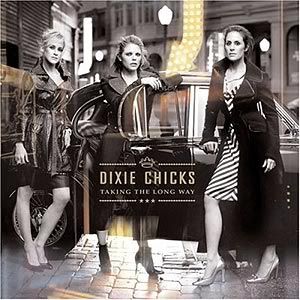
Because of their courage, and because I enjoy their musical talent, I frequently listen to their albums. Home and Fly have lately dominated my CD player, and I've added tracks from Taking the Long Way to my Revising Mr. Right playlist. At some point, I'll be posting that playlist in full. But in the mean time, I encourage our readers to celebrate the basic human right to free speech... and by standing up for your own beliefs, as well.
And to all my fellow American scribbling women out there: Happy Independence Day.

Tuesday, May 23, 2006

Now what is love? I pray thee, tell

Yet what is love? I pray thee sain.
It is a sunshine mixed with rain;
It is a tooth-ache, or like pain;

It is a game where none hath gain;

The lass saith no, and would full fain:
And this is love, as I hear sain.

Yet what is love? I pray thee say.

It is a yea, it is a nay,

A pretty kind of sporting fray;

It is a thing will soon away;

Then take the vantage while you may:

And this is love, as I hear say.
— Sir Walter Raleigh


The spirited debate on love--functional, dysfunctional, ethical, selfish and otherwise--that the Grey's Anatomy finale inspired in our comments section got me pondering the subject that dramatists, poets, etc. have pondered for centuries. Does true love require pain? Madness? The rejection of all else? Or is it something far more rational and practical and orderly?

Seeing that I'm an aspiring romance novelist, my take on the subject may surprise. But I don't believe in perfect love. I don't believe "true" love is willing to flout all laws, conventions and morals to be with the loved object. I believe what a lot of people celebrate as true love is really just redirected narcissismism.

I do believe in soul mates. I do believe there is a right person out there for everyone. But I also know that keeping a marriage together takes work and effort and sacrifice, and that a person who behaves wrongly toward others in the name of "love" will eventually behave wrongly in spite of love.

So how does a girl write romance without all the angst? Very carefully. Romance novels require confusion and obstacles and arguments and missed cues and mixed messages. But I hope that my characters have a kindness toward each other and an understanding of each other that transcends the drama. I hope they behave better because of their relationship, not worse. I hope to never write a book in which readers can't picture my characters having a happy, contented, fulfilling life together after the action is finished. I'd like my eventual readers to be able to close the book and picture my characters as an old man and woman sitting alone in a room, not saying anything but happy to be near one another. That to me is true love.

Monday, May 15, 2006

Live Free Or... Shop At Barnes & Nobles?

Interesting article in Slate today about the importance or lack thereof of the "death" of the independent bookstore. I have to ruefully confess that I do most of my bookshopping, such as it is, at the Barnes and Noble 4 blocks from my apartment. But when I'm at my parents' home in the suburbs, I split my time between the chain store and the local book and record exchange, where I buy (and unload) most of my romance reading.

I haven't found a similarly great, romance-based used book store here in the city. Is there one? If any of our phantom readers knows of a great NYC store, holla, okay? As it is, I'm forced to unload the non-keepers on my unsuspecting – err, grateful friends.

For all Tyler Cowen's pooh-poohing of the importance of the indies, I think the fill an important function in genre fiction. While independent general bookstores have faded away, those focused on romance or mystery or children's writing still manage to persist. Perhaps it's because, with the tremendous volume of books published in each of those areas each month, let alone each year, readers value the guidance ofknowledgeablee owners who can steer them toward great newcomers and away from the duds.

Or maybe I'm crazy and those stores are all fading just as fast.

How about you? Where do you buy your books? What's your take on Indies vs. Chainies (Cheneys!)?

Thursday, February 02, 2006

Groundhogs are for Poetry

Today is the day for blogger-wide silent poetry readings (which I learned of on Knitting Underway). I knew I wanted to post some Donne, my favorite poet of all. But rather than my trusty stand-by, favorite poem and likely wedding program motif "The Goodmorrow," I'm going a little religious. Not something often seen on this blog, but if anyone can make religion seem sexy, it's dear old John. And while this reading's supposed to be silent, if you read the poem aloud it's that much better:

Holy Sonnet XIV

Batter my heart, three-person'd God ; for you
As yet but knock ; breathe, shine, and seek to mend ;
That I may rise, and stand, o'erthrow me, and bend
Your force, to break, blow, burn, and make me new.
I, like an usurp'd town, to another due,
Labour to admit you, but O, to no end.
Reason, your viceroy in me, me should defend,
But is captived, and proves weak or untrue.
Yet dearly I love you, and would be loved fain,
But am betroth'd unto your enemy ;
Divorce me, untie, or break that knot again,
Take me to you, imprison me, for I,
Except you enthrall me, never shall be free,
Nor ever chaste, except you ravish me.

Friday, January 20, 2006

Romance Fans in Unlikely Places

As preparation for an upcoming grad school interview (also known as "attempt to use my wit, wisdom, stawberry-fresh hair and vast appreciation of her corpus of work to charm senior professor into pulling for me with the admissions committee") I've been reading Mary Poovey's book "The Woman Writer and the Proper Lady." It's a really interesting look at Mary Wollstonecraft, Mary Shelley and Jane Austen and the ways each of them reacted to and against the myth of the "Proper Woman," which developed at the beginning of the nineteenth century and really took root in the Victorian period. I know it sounds dry, but it's fascinating and, hey, this is what I want to go to school for, right?

One of the quirks of my NYPL-issued copy (thank God for the Mid-Manhattan circulating branch) is that at least two, and possibly three of the book's previous readers have provided copious and sometimes entertaining notes in the margins. They include brief summaries of Poovey's major points, ammendments to her arguments and sometimes outright denials (I've seen "NO!" and "I don't think so" written a few times).

But imagine my surprise when, deep in a chapter about prostitution as empowerment in Wollstonecraft's final, unfinished novel Maria, I see the note "See The Bride of the Unicorn, Kasey Michaels."

I read Kasey Michaels! I read the Bride of the Unicorn! A later note about Joan Smith's A Kiss In the Dark sealed the deal.

Romance readers a clever bunch, no?

Sunday, November 13, 2005

230 Questions... And Not One on Jenny Crusie

I am a bad, bad NaNo contestant and I deserve to be spanked. Or at least dropped by my critique/blog partner.

I am officially out. I thought I could handle a new ms, but I was beaten before I even started. Well, you know what they say. Don't hate the game, hate the size of the dog in the player. And now I suddenly want to watch Laguna Beach.

The revisions continue. I've reached the middle and the real work begins. Mashing chapters together. Removing characters -- I killed off an entire family of servants, and took a little too much joy in it. Oh, Jarvis family, we hardly knew ye! And adding scintillating yet wacky tidbits about Parliamentary procedure.

And getting my ass kicked 18th-century style by the GRE subject test in Literature. I think I may have finally uncovered the most perfect instrument of torture ever devised by man or woman. Take a small child. Teach her to read early. Tell her how very, very good they are at English all their life. Encourage her to apply for a freaking PhD, for God's sake. And then spend 3 hours slowly stripping away any ounce of belief she had in her ability to do graduate work. Add a massive head cold and a fever, and the pain is pretty much complete.

Seriously, is there not something massively wrong with asking one to differentiate between excerpts of Pope and Johnson when they're both written in heroic couplets? That's just stacking the deck!

If it weren't for blueberry pancakes, a wonderful house guest from out of town and a massive plate of bacon, I would probably be crouched on the sidewalk somewhere near Washington Square, rocking back and forth and asking passers-by to hold me.